What to Look for in a Knitted Fabric Supplier (It's Not What You Think)
The question you're asking is the wrong one
Search for "what to look for in a knitted fabric supplier" and you'll get the same polite list: price, MOQ, lead time, certifications. That list isn't wrong. It's just dangerously incomplete.
I'm a fabric sourcing specialist. In the last eight years, I've handled more than 200 rush orders, including same-day turnarounds for color approvals. In March 2024, I stood in a factory warehouse at 3 a.m. with 36 hours before a client's production deadline. The fabric was three days late. The supplier said it was "almost ready." If you work in this industry, you know what that phrase means.
The real question isn't "Can this supplier make knitted fabric?" It's "Can this supplier make my knitted fabric, every time, even when things go wrong?"
Why a price list doesn't tell you what a factory can do
Knitted fabric is not one category. A circular knit machine, a flatbed machine, and a warp knit machine produce completely different goods. A supplier can make a beautiful "Loro Piana wool fabric"-style suiting and still be lost on a rayon jersey. That's not a criticism. It's a reason to ask better questions.
A while ago, a client asked me to look at the construction behind the Loro Piana Nari honeycomb knit straw hat. We didn't need to copy it. We needed a similar breathable, structured hand. The honeycomb cell has to come from the knitting, not from a print. I called six knitted fabric suppliers. Four said "no problem." One asked what honeycomb meant. One asked how the pattern would behave at the selvedge and whether we'd allow a hem allowance. The surprise wasn't the price difference. It was how many people said yes to something they'd never worked with.
If you're searching for "rayon fabric manufacturer" or "rayon fabric oem," the same lesson applies. Rayon can be woven or knitted. It can be spun dyed or piece dyed, calendered or brushed, blended with elastane or kept pure. The supplier's expertise is in those choices, not in an inventory list.
Rush orders are where the real problems show up
When I'm triaging a rush order, the first thing I listen for is questions. A reliable supplier asks: exact construction, finished width, dye lot tolerance, Oeko-Tex or other certificates, the drop-dead date, and what happens if we miss it. They sound annoying. They're annoying in the best way.
The less reliable supplier says "no problem" immediately. That should worry you. It took me three years and about 150 orders to learn that a quick "yes" is not the same as a plan. In March 2024, a private-label apparel brand needed 1,200 meters of a specific rayon jersey in six days. Normal lead time was three weeks. The first manufacturer had a lower price and open capacity. The second asked four questions, quoted a rush fee, and blocked a production line. We went back and forth for a day and a half. The first one made sense on paper. The second one made sense on the floor. We chose the second one. It arrived 11 hours before the deadline. Missing that deadline would have cost the brand their retail launch slot.
Even after choosing, I kept second-guessing. The cheaper option was still available, and the rush fee hurt. I didn't relax until the fabric came in. After three failed rush orders with discount vendors, our policy is now simple: no new supplier for urgent jobs unless they send a written production plan with a named QC contact. It's not a guarantee. It's risk management.
What a bad supplier actually costs you
Let's talk about price. Honest? The lowest quote is usually a trap.
Total cost of ownership includes base price, setup fees, shipping, rush fees, rejected inventory, and the cost of a missed launch. If a fabric is $4.80/m but 12% ends up as waste, the real cost is higher than a $6.20/m fabric with 2% waste. I've seen buyers choose the cheaper fabric and then pay $800 in express freight to replace off-spec rolls. The "cheap" order became the most expensive one on the invoice.
Also, if a supplier says "eco-friendly" or "recyclable" rayon, ask for the paperwork. Per the FTC Green Guides (16 CFR Part 260), environmental claims have to be truthful and substantiated. A "recyclable" claim, for example, can be misleading if recycling facilities aren't available to at least 60% of consumers. The same goes for "Italian wool" or "responsibly sourced" anything. A certificate of origin or a chain-of-custody document is the minimum.
The way I evaluate suppliers now
I still look at price, MOQ, and lead time. They're the baseline. The filter is process.
Here's what I actually check now, whether I'm sourcing Loro Piana wool fabric, commissioning a rayon fabric oem, or testing a honeycomb knit structure for a hat:
- Ask about QC on a repeat order. Samples are one-time moments. Dye lot consistency across production runs is the real test.
- Ask how they handle a defect. No supplier is perfect. The difference is whether they have a procedure or just an excuse.
- Ask about the construction, not just the fiber. Gauge, pattern repeat, finishing, stretch, shrinkage. The right supplier will ask you questions before quoting.
- Get the total cost in writing. Base price, setup, freight, rush fee, waste allowance. If one line is missing, assume it's coming later.
We use the same logic on our side. After we standardized our spec sheets and sample forms, our sampling resubmissions dropped by about 40%. That wasn't because we suddenly bought better fabric. It's because the process got clearer. A supplier's process should do the same for you.
The bottom line
The value of guaranteed turnaround isn't the speed—it's the certainty.
That's the line I repeat whenever someone asks what to look for in a knitted fabric supplier.
Most sourcing guides say "check the quality, check the price, check the lead time." I'd add: check what happens when the deadline is tight, when a dye lot doesn't match, and when the fabric doesn't behave the way the sample did. That's where the future relationship is decided.
There's something satisfying about a perfectly executed rush order. After the stress, the emails, and the anxiety, seeing the fabric delivered on time and right—that's the payoff. It doesn't happen by luck. It happens because someone looked past the catalog and asked the uncomfortable questions.
Whether you're chasing a premium hand for a Loro Piana wool fabric project, building a private label around a rayon fabric oem, or simply using the Loro Piana Nari honeycomb knit straw hat as a lesson in structure, the filter is the same. Look for process. Look for caveats. Look for a supplier who asks what you mean instead of telling you what you want to hear.
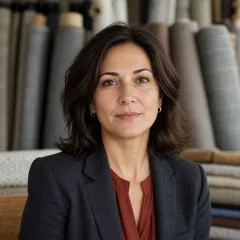
Lucia Bianchi is a woven apparel-fabric analyst covering cotton, linen, wool, rayon, denim, shirting, twill, satin, poplin, and blended garment fabrics. She applies the ISO 1833 series for fibre composition and ISO 105-C06 for laundering colourfastness while checking GSM, yarn count, usable width, shrinkage, skew, shade grade, drape, and surface defects. Her specification guides help designers, sourcing teams, and mills align fibre claims, lab dips, bulk tolerances, care conditions, and garment performance before production approval.