What Ordering Loro Piana Wool Fabric Taught Me About Picking a Garment Fabric Distributor
The Short Version
After 200+ orders—maybe 180, I'd have to check the system—the most important thing I know about choosing a garment fabric distributor is this: it's not price, and it's not lead time. The best distributor is the one who tells you when they're not the right partner for the project. That kind of honesty has saved me more money than any 'lowest price guarantee' ever did.
I'm the office administrator for a 40-person product development studio. I manage all fabric and trim ordering—roughly $180,000 a year across 12 vendors. I report to both operations and finance. When I took over purchasing in 2020, I didn't know the difference between a knitting mill and a converter. I learned by making mistakes. This is the buying guide I wish I'd had.
How I Learned the Hard Way
In my first year, I made the classic specification error: I assumed 'standard' meant the same thing to every vendor. I approved a quote for 'standard cotton knit' for a private-label project. What arrived was a 6.2 oz jersey when we'd planned for 7.5 oz. The garments sewed up fine, but the hand feel was wrong. We had to redo the entire sampling round—a $600 mistake.
Then there was the communication failure. I said 'as soon as possible' to a denim distributor. He heard 'whenever convenient.' The order showed up two weeks after the date I'd silently set. We were using the same words but meaning different things. Now I always provide a required-in-hands date and build in a two-day buffer.
What I Ask Every Garment Fabric Distributor Now
I've simplified my process to three questions. They work whether I'm sourcing Loro Piana wool fabric, setting up a knit fabric private label, or getting quotes from a denim fabric distributor for a new season.
- What do you do well—and what don't you do? If the answer is 'we do everything,' that's a red flag. A specialist who says 'this isn't our strength—here's who does it better' is someone I want to work with again.
- What are your actual minimums and lead times? I've been surprised at how many quotes skip this. Get it in writing.
- Who would you recommend if you couldn't fulfill this order? A confident distributor answers without hesitation. A desperate one says 'we can handle it' even when they can't.
On Loro Piana Wool Fabric
When a supplier says they carry Loro Piana wool fabric, I ask for the specific line and composition. The phrase 'Loro Piana-style' means nothing. I once ordered what looked like a comparable cashmere-wool blend, and it pilled after one wear test. Real Loro Piana wool fabric has a drape and hand that come from fiber selection and finishing, not just the fiber percentage. If you're buying it through a distributor, make them prove they have access to the actual mill line.
I do not have hard data on how many distributors claim access to ultra-premium wool when they don't. But based on my experience, my sense is it's more common in 'direct from Italy' listings than people admit.
On Knit Fabric Private Label
For a knit fabric private label, the game changes. You're putting your own name on the product, so quality tolerance has to be tight. I ask about AQL, dye lot consistency, and how the supplier handles shade variations. If a distributor can't explain their quality control process, they're not ready for private label work. I also ask about minimums: a good knit supplier will offer a small pilot run instead of pretending it's efficient.
The Denim Fabric Distributor Buying Guide in Three Lines
Denim is its own species. If I need selvedge, I ask about loom type, weight, indigo process, and whether a finish has already been applied. A reliable denim distributor asks me about shrinkage and stretch before quoting. A less reliable one says 'standard' and 'same as everyone.' The denim fabric distributor buying guide you actually need is short: use someone who handles denim daily, request a pre-production swatch with the finish, and never order from a photo.
When the Product Is Actually an Accessory
Specialty products need specialty channels. The Loro Piana Nari honeycomb knit straw hat, for example, is not a denim distributor's project. It's a structured knit straw accessory that requires a completely different supply chain. If you ask a generalist to source something like it, you'll wait weeks and get excuses. Find the specialist who already carries that category.
Pricing Reality Check
From my own files: in Q3 2024, I quoted specialty wool suiting and cashmere blends through three distributors. Comparable Loro Piana wool fabric came in around $45–$85 per yard for small cuts, depending on line and volume. Basic knit jersey for private label was $8–$16 per yard at the same time. Those are my quotes, not universal rates—verify current pricing before you commit. (Source: my Q3 2024 vendor quotes)
The lowest quoted price is rarely the lowest total cost. A distributor may charge extra for sample shipping, finishing, or re-cutting after a defect. Add those up before comparing.
When a Big Distributor Isn't the Answer
I'll be honest about the edges. If you need one roll of an unusual cloth for a sample test, or you need fabric in hand the same day, a large garment fabric distributor may not be the best route. A local jobber or a direct mill relationship can serve you better. Same if you need certified organic or compliance documentation—ask for certificates before you order. I once trusted a 'sustainable' label from a distributor without asking for the cert. That delayed a project by two weeks.
Ask the Uncomfortable Question First
So my advice is simple. Before you dive into swatches and price comparisons, ask one question: 'What shouldn't I buy from you?' The answer will tell you more than the catalog. The distributor who admits a gap is the one who'll be honest about the details that matter.
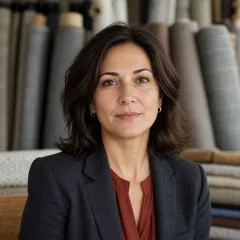
Lucia Bianchi is a woven apparel-fabric analyst covering cotton, linen, wool, rayon, denim, shirting, twill, satin, poplin, and blended garment fabrics. She applies the ISO 1833 series for fibre composition and ISO 105-C06 for laundering colourfastness while checking GSM, yarn count, usable width, shrinkage, skew, shade grade, drape, and surface defects. Her specification guides help designers, sourcing teams, and mills align fibre claims, lab dips, bulk tolerances, care conditions, and garment performance before production approval.