Why Loro Piana Wool Fabric Isn't for Every Order—and How to Buy It When It Is
I'm going to say something that sounds wrong coming from someone who sources premium fabric all day: Loro Piana wool fabric is overkill for most B2B apparel orders. That's not a dig at the brand. It's the reason I've been able to keep clients profitable and on schedule. Understanding when a luxury wool fabric manufacturer like Loro Piana is actually worth the premium is the whole game.
In my role coordinating fabric sourcing for garment manufacturers and private-label brands, I've handled more than 350 rush orders in the last six years. Those include same-day turnarounds for buyers who overslept on a production deadline. I've learned, often the hard way, that the most expensive option is rarely the best and the cheapest option is rarely the cheapest.
Where the 'Any Mill Can Do It' Argument Falls Apart
The first question I get from buyers is usually: 'Why not just buy the Loro Piana equivalent from a wool fabric manufacturer in Turkey, Portugal, or South Korea at 40% less?'
Fair question. In some categories, the equivalent is genuinely close. But the gap lives in three places that don't show up in a price quote:
- Fiber selection. Loro Piana's sourcing network for extra-fine merino, cashmere, and vicuna is still the benchmark. A mill can buy the same micron count on paper, but they don't always get the same staple length and handle.
- Spinning and dyeing. The way the yarn is spun changes how the fabric takes dye, how it drapes, and how it resists pilling. That's not visible in a weft count.
- Finishing consistency. With Loro Piana fabrics, the final finish tends to be reproducible across dye lots. With cheaper equivalents, I've seen the same item sku arrive with visibly different hand feel from one shipment to the next.
People think premium fabric costs more because of the brand name. Actually, the causation runs the other way: the brand can charge more because they invest heavily in consistency. If you don't need that consistency for production, you're paying for something you won't end up using.
What Loro Piana Fabrics Actually Do Differently
According to Loro Piana's published company history at loropiana.com, the company has roots in Trivero, Italy, dating back to 1924. The fabric archive they've built since then is not just about prestige. It's about understanding how rare natural fibers behave under pressure.
What I notice most as a distributor is the fabric's behavior at the cutting table. If you've ever worked with a cheap stretch suiting that keeps curling, you know what I mean. With Loro Piana wool fabric, the grain stays truer, the bias drapes the way the pattern expects, and the finished garment holds its shape longer. That's hard to measure in a lab test, but it's obvious to a cutter.
For bulk knitted fabric programs, consistency matters even more. A Loro Piana cashmere-wool knit isn't just about the micron count. The spinning affects how the fabric recovers after stretching. In my experience, that's the part generic mills miss. It's also the part that leads to costly garment returns if you're shipping at scale.
The Emergency-Sourcing Reality Check
Here's the part nobody tells you about Loro Piana fabrics: they're not a quick-turn solution. If you need 1,000 meters of a standard woven in four weeks, you're better off with a mid-tier wool fabric manufacturer who has roll stock sitting in a warehouse waiting for you.
In September 2024, a private-label client called on a Wednesday afternoon. They needed 1,800 meters of Loro Piana wool fabric for a capsule that had to reach a stylist in Los Angeles in 21 days. Normal lead time from the mill is realistically 8 to 12 weeks for a woven order, and longer if the fabric isn't in their standard sortiment.
After three calls to our vetted distributors, we found 1,400 meters of a close colorway from existing roll stock, paid an $11,000 premium to hold it, and had the remaining 400 meters matched by a partner mill in Prato using equivalent lots. The alternative was losing a $48,000 order. I should add that the original plan had been to use a cheaper substitute, and that substitute got delayed. That's why we ended up in the emergency. Put another way: don't do what I did.
I don't have hard data on exactly how often premium fabric orders fail due to lead time assumptions. But based on six years of our orders, my sense is that timeline misalignment causes more problems than quality ever does. Buyers are usually loyal to the brand, but not to the reality of production calendars.
When I'd Tell You to Step Away from Loro Piana
If you've ever had a supplier tell you 'we handle Loro Piana too,' you know that most of them are just talking about occasional sample orders. Here's what you need to know: Loro Piana fabrics are usually the wrong fit if any of these are true:
- Your margin structure can't absorb a premium fabric. If the retail price target is $39 for a blazer, stop reading.
- You need immediate stock. No distributor, including us, can make eight weeks of production appear overnight. Sometimes we can find reserve inventory, but that's exceptional, not reliable.
- You're treating 'Loro Piana' as a marketing label. If you don't need the fiber performance, a cheaper fabric with the same color will sell just as well.
- You're ordering basic interlock or simple jersey in huge volumes. For bulk knitted fabric in low-value silhouettes, the quality difference won't be visible to the end consumer.
There's also the question of technical performance. Loro Piana has some excellent water-repellent and travel-friendly finishes, but if you need a fabric that survives industrial washing at high temperatures or meets a specific waterproof membrane requirement, a synthetic or treated fabric will often outperform. That's not a criticism of Loro Piana. It's a reminder that the best fabric depends on the end use.
What to Ask Before You Order: A Short Apparel Fabric Distributor Buying Guide
If you're reading this as a buying guide, start with these four questions before calling any supplier:
- Is the fiber spec actually exceptional? Ask for the micron count and staple length. If the numbers aren't special, the brand name is doing all the work.
- Do you need brand-specific performance? Loro Piana fabrics offer high-level natural fiber comfort, but they're not the only route to strength, stretch, or easy care.
- What is the real lead time? Ask the mill directly, then add 30% for buffer. If that number doesn't fit your production launch, look elsewhere.
- Is this a hero style or a filler? Use premium fabric for the pieces that carry your collection. Use more accessible fabrics for basics and experiment-only styles.
I once said to a mill, 'We need Loro Piana quality.' They heard 'same weight and color.' We discovered the miscommunication at sampling stage, when the hand feel was completely different. It wasn't a malicious substitution—it was a communication failure. Since then, my team ships a physical reference swatch whenever the phrase 'equivalent quality' comes up. Trust me on this one: words won't protect you.
The Bottom Line
Will some mills claim they make Loro Piana wool fabric at half the price? Yes. Sometimes it's true. More often, it isn't. But that doesn't mean you're wrong to choose a more practical option for your product range.
In my opinion, the smart way to buy Loro Piana fabrics is to treat them as a strategic choice, not a status symbol. Use them where they make the product meaningfully better. Skip them where they don't. If you're building a $1,200 tailored jacket, start here. If you're building a $49 seasonal dress, don't.
The bottom line is simple: Loro Piana wool fabric is the right answer for a narrow, high-stakes set of problems. When your garment's entire identity depends on the hand feel, drape, and durability of the cloth, it's a no-brainer. For everything else, the smartest move is knowing when to say no—even as a distributor who benefits when you say yes.
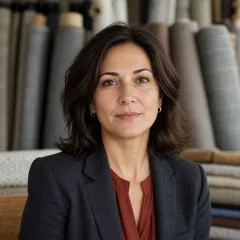
Lucia Bianchi is a woven apparel-fabric analyst covering cotton, linen, wool, rayon, denim, shirting, twill, satin, poplin, and blended garment fabrics. She applies the ISO 1833 series for fibre composition and ISO 105-C06 for laundering colourfastness while checking GSM, yarn count, usable width, shrinkage, skew, shade grade, drape, and surface defects. Her specification guides help designers, sourcing teams, and mills align fibre claims, lab dips, bulk tolerances, care conditions, and garment performance before production approval.