Loro Piana Wool Fabric vs. Price-Led Mills: What Private-Label Buyers Should Actually Compare
-
What to Compare When You See the Price of Loro Piana Wool Fabric
-
Comparison 1: The Quote vs. the Cost Per Finished Garment
-
Comparison 2: Delivery Dates — A Plan vs. a Promise
- Comparison 3: There's No Such Thing as a 'Safe' Fabric
-
Comparison 4: Fabric Alone vs. Yarn and Fabric Together
-
So Which Supplier Should a Private-Label Brand Choose?
Fabric-sourcing conversations tend to end the same way: with a number. The price per meter, the discount at 500 meters, the promise that 'the mill can get close.'
I've sat on both sides of those conversations. Early in my career I was placing private-label garment fabric orders; now I coordinate fabric and yarn supply at Loro Piana. Buyers call us expecting a lecture on Italian quality. I usually end up talking about cost instead.
Not the cost on the invoice — the cost of what happens after the invoice.
What to Compare When You See the Price of Loro Piana Wool Fabric
If you're comparing Loro Piana wool fabric with a lower-priced offer, you don't need a lecture on heritage, and you shouldn't get one from me. Loro Piana has been making luxury natural-fiber fabrics since 1924, but that history doesn't automatically justify every purchase decision. What justifies a premium fabric is lower total cost, not a nice origin story.
I use four tests when I compare suppliers, whether I'm buying or selling. What will this fabric cost after cutting and sewing, not just before? Is the delivery date a plan or a promise? What happens when the brand needs a reorder six months later? And how much of the supply chain can one supplier cover coherently?
Comparison 1: The Quote vs. the Cost Per Finished Garment
Let me use a recent example. In the fall 2024 season, a brand bought what looked like a good-value wool stretch suiting from an agent. The hand feel was fine and the lab tests were adequate. But when the cutting room opened the rolls, the finished width varied. One roll was 148 cm; the next was 151 cm; the marker was planned for 150 cm. On an 800-layer spread, that is not a small difference.
Cutting had to stop. The marker was remade. The pieces already cut from the narrow roll had to be re-cut from new fabric. The replacement order was a rush, which cost extra, and the factory suddenly had a weekend of overtime. By the time it was resolved, the production manager told me the project had cost more than the premium quote they had tried to avoid in the first place.
That's how I think about garment fabric private label: a purchase is never just a purchase. It becomes layers, markers, seams, inspections. If fabric doesn't behave consistently, the extra cost doesn't show up on the supplier's invoice. It shows up in the sewing line, the QC bench, and the container that ships late.
When I evaluate a stretch fabric manufacturer, the same rule applies. I don't ask for stretch percentage first; I ask for recovery data. A fabric that stretches 40% and doesn't return is not technical — it's a liability. The cheapest meter of stretch fabric is very expensive if the garment loses its shape after two wears.
Comparison 2: Delivery Dates — A Plan vs. a Promise
The second cost is time.
In my role I see two versions of a delivery date. There's the date a supplier types into an email, and there's the date the supplier can defend with production records, yarn availability, and dye-lot history. Those are different things.
Last October, a private-label customer in Tokyo needed 400 extra meters of a wool coating ten days before their shipping date. Same article, same color code, no time for a new strike-off. Because we could trace the original order — which yarn lot, which dye lot, how much of that shade was still available — we could answer in hours. Not every urgent request gets a yes, but when it can be done, a supplier with records is the one that can do it.
That tends to surprise people. The assumption is that big mills are slow and inflexible, while small agents are fast. In my experience, it's the opposite when things go wrong. The 'small fast agent' doesn't know which mill spun the yarn, so they can't verify anything. They can only re-promise.
A delivery date without traceability is not a promise. It's a sentence in an email.
I don't mean premium suppliers are never late. Even the best-run mills miss dates occasionally. But there's a difference between a supplier who can say 'here's exactly what happened and here's the fix,' and one who can only say 'let me check with the mill.' When a deadline is at stake, one of those answers costs far less.
Comparison 3: There's No Such Thing as a 'Safe' Fabric
Shirting deserves a separate comparison because shirting failures are quiet. A shirting fabric rarely fails dramatically; it fails after the first wash, when the collar starts to roll, or when two cuts from the same roll show a shade difference that's only visible in daylight. By then the fabric is already inside a garment.
What to look for in a shirting fabric supplier
Here's the checklist I use when I have to choose a shirting supplier, regardless of price tier:
- Ask who the actual manufacturer is. 'We work with a mill in the north' is not an answer. If a supplier can't name the weaver or the spinner, they won't be able to fix problems, let alone repeat an order.
- Ask for the shade tolerance in writing. A serious supplier will provide a shade band per dye lot and a tolerance of 4–5 on the grey scale. A vague 'it should be close' is a warning.
- Ask for guaranteed shrinkage after the first wash. A specific number with a test method is a spec. 'About three percent' is not a spec.
- Ask for the fibre composition in terms that can go on a label. Under Regulation (EU) No 1007/2011, textile products sold in Europe have to state fibre names and composition accurately. If your supplier can't tell you exactly what is in the roll, your garment label can't tell your customer either.
Comparison 4: Fabric Alone vs. Yarn and Fabric Together
The fourth comparison is less obvious but often the biggest total-cost item: breadth.
Many premium private-label programs start with one product — a coat, a blazer in wool, maybe a tailored trouser — and then expand into knitwear. That's when 'Loro Piana wool fabric' becomes 'we also need Loro Piana yarn in a matching colour and hand.'
If you buy those from different suppliers, you own the coordination risk. Two mills, two shade-standard systems, two delivery calendars. You spend weeks getting a sweater yarn to match a woven cloth that was finished weeks earlier, and the small differences become your problem.
It took me years to appreciate this. I started my career thinking the best fabric came from one specialist and the best yarn from another. That's not always wrong — plenty of specialised mills do excellent work. But for a private-label garment brand, the goal isn't the best single component; it's a collection that looks like it was designed together. When one supplier can provide the woven wool fabric and the matching yarn, the standards are aligned before the first strike-off.
There's a quiet satisfaction in seeing a knit sample placed next to a woven jacket and knowing the depth of colour is coherent — not identical, but coherent. That coherence is a selling point. Buy it piecemeal at the last minute and it's nearly impossible to achieve.
So Which Supplier Should a Private-Label Brand Choose?
I'm not going to tell you the lower-priced mill is never the right answer. That would be too easy. If your brand competes on price, your products have short lifecycles, and reorders aren't part of your model, a price-led supplier might be the best total-cost choice.
But if the style will be reordered, if it will be cut in large lays, or if it carries your customer's label rather than yours, compare the total cost. Compare the cost per finished garment, not per meter. Compare what happens when the delivery is late, when the shade is questionable, when the fabric needs to be repeated after six months.
Price is what you pay to bring fabric through the door. Total cost is what you pay to send it out again as a garment. I've stopped comparing at the door. After a few dozen rush orders and one very expensive penalty clause, I'd rather buy the certainty.
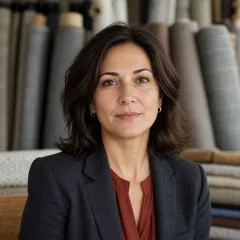
Lucia Bianchi is a woven apparel-fabric analyst covering cotton, linen, wool, rayon, denim, shirting, twill, satin, poplin, and blended garment fabrics. She applies the ISO 1833 series for fibre composition and ISO 105-C06 for laundering colourfastness while checking GSM, yarn count, usable width, shrinkage, skew, shade grade, drape, and surface defects. Her specification guides help designers, sourcing teams, and mills align fibre claims, lab dips, bulk tolerances, care conditions, and garment performance before production approval.