How to Choose Woven Fabric for Wholesale: Stop Pricing by the Yard
-
The surface problem: everyone thinks it's about finding a "trustworthy" supplier
- The deep problem #1: unit price only shows you the visible 20%
-
The deep problem #2: brand names become a shortcut for evidence
-
The deep problem #3: MOQ and lead time are part of the price
-
The real cost of getting this wrong
-
The solution (it's shorter than you'd expect)
If you search "how to choose woven fabric for wholesale," you get the same advice everywhere: check the composition, check the GSM, compare the price per yard, and pick the lowest number. That's roughly what I did when I took over fabric purchasing in 2021. It cost us about $18,000 in the first two years. Not in the prices we paid. In everything that happened after the invoice.
I'm the procurement coordinator at a garment manufacturer that runs about 200,000 woven units per year—shirts, trousers, light outerwear. I manage fabric sourcing for roughly $800K to $1M annually across 8 or 9 mills, and I report to both operations and finance. That last part matters, because it means I hear about every problem a bad fabric order creates. So when someone asks me how to choose woven fabric for wholesale, I don't start with fabric. I start with what it cost me to learn this.
The surface problem: everyone thinks it's about finding a "trustworthy" supplier
Most buyers I talk to mean one thing when they ask about woven fabric sourcing: how do I find a mill that won't rip me off? They want a name, a region, a price range. I get why. That's exactly how I started. The industry makes it look like a matching problem—pair your specs with a supplier, get a quote, done.
The surface problem is real. There are hundreds of mills, agents, and trading companies. Swatches look beautiful in the sample book. Prices swing wildly for the same written spec. But that's not the actual problem. The actual problem is that we measure the decision all wrong. We compare the price of the fabric. We should be comparing the cost of the order.
The deep problem #1: unit price only shows you the visible 20%
In early 2023, I found a great price on bulk poplin fabric for a shirt program. New mill, $0.45 per yard under our regular supplier. On a 12,000-yard order, that's $5,400 in savings. I knew I should order pre-production yardage and run wash tests. But we were behind schedule, and I thought—what are the odds? A poplin shirt is a poplin shirt.
The odds caught up with me. That bulk poplin fabric had one dye lot that was fine and two that were visibly different under production lighting. The cutting room caught it in the second lot—after 2,200 shirts had already been cut. We re-cut everything, reordered from our regular mill, and lost three days of line time.
When I added up the re-cut material, overtime, and rescheduled production, the "cheap" poplin ended up costing about $0.62 per yard more than our regular mill. The $5,400 saving turned into a loss. That was the day I stopped comparing unit price.
What you're actually buying
When you buy woven fabric wholesale, you're not buying cloth. You're buying four things, and only one of them shows up on the quote:
- Yield. How much usable fabric you get after shrinkage, skew, and width variation. A fabric that shrinks 2% more than spec doesn't just shrink—it fails QC after cutting, and the whole batch becomes seconds.
- Lot consistency. Whether rolls inside one dye lot match each other, and whether the next production lot matches the first. If the shade drifts, you don't have a fabric problem. You have a rework problem.
- Reliability of information. Whether the spec sheet means what it says. I've had mills send a swatch from one production batch and ship from a totally different recipe. That's not a mistake. That's a process failure.
- Unit price. The least informative number in the entire transaction.
The deep problem #2: brand names become a shortcut for evidence
Here's the part that surprised me. I spend a lot of time looking at Loro Piana wool fabric—any buyer sourcing woven wool for outerwear does. Search "loro piana wool fabric" online and you'll see what the top of the market actually looks like. It's impossible not to run into loro piana fabrics in the premium suiting space. I used to assume most of the price gap was brand markup. But after visiting enough mills and seeing how the top tier runs quality systems—documented sourcing, lot traceability, checks at every stage—I changed my mind. The premium isn't just a name. It's a process you can verify.
To be fair, that level of process isn't something every order needs. You don't need Loro Piana-level discipline for a basic poplin shirt. But you do need evidence that whatever mill you pick has discipline proportional to what you're making.
The surprise wasn't that the famous mills were good. It was that a mid-sized denim fabric manufacturer nobody had heard of gave us far fewer problems than two widely known names. Their process was tighter for our volume.
And that's the trap: we use names as shortcuts for process evidence. If a denim fabric manufacturer has a famous name, we trust the name and skip verification. That's backwards. The name is the result of the process. The process is what you need to check.
The deep problem #3: MOQ and lead time are part of the price
The third trap is the one nobody warns you about: your total cost lives in the terms, not the unit price.
A few years ago, I weighed whether to switch denim suppliers for a new jeans program. The upside was a 9% material saving. The risk was that the new denim fabric manufacturer required a 30% higher MOQ and a week longer lead time. I kept asking myself: is a 9% saving worth potentially missing our retail ship date? I calculated the worst case—a missed window would mean air-freighting finished goods, which would erase the saving and then some. The expected value said go, but the downside felt too big. I passed.
Three months later, that same mill missed a deadline for an order roughly the size we would have placed. I don't know the details, and I'm not going to name them—the market is full of stories like this. The point is that MOQ and lead time aren't administrative details. A minimum order 30% bigger than your normal first run means extra inventory you haven't sold. A week longer lead time means financing materials longer and hoping the colorway hasn't shifted by the time the fabric lands. None of that shows up on the quote. All of it hits your bottom line.
The real cost of getting this wrong
Let me give you the number that changed how I buy. Our VP of operations still jokes about the "cheapest denim we ever bought." The mill delivered eight rolls with indigo shade drifting from roll to roll. We tried to hold them to the spec. They argued. We compromised. The finished jeans looked like patchwork. A major retailer accepted 60% of the order; the rest went to discount channels at cost.
The fabric was not cheap. It was the most expensive denim we bought that year.
The total damage came to roughly $14,000 on a $48,000 order. Looking back, I should have ordered one production lot and tested it before committing to the full volume. At the time, the swatch looked perfect and the price was the headline. The decision that looks like smart negotiation at the quote stage is the one that puts your name on a rejection report two months later.
The solution (it's shorter than you'd expect)
So how do you choose woven fabric for wholesale? After four years, here's what actually works. It isn't a secret method. It's a different place to put your attention.
- Test the fabric the way your factory will use it. Shrinkage, skew, wash tests—on yardage from production, not just from the sample book.
- Get lot-to-lot tolerances in writing. Shade depth, shrinkage, width. In my experience, the mills that hesitate to put numbers on paper are the ones that miss them.
- Insist on pre-shipment inspection from bulk production. If a mill refuses third-party checks, you've learned all you need to know.
- Verify claims with documentation. Per the FTC Green Guides (ftc.gov), environmental claims like "sustainable" have to be substantiated. We ask for the test report behind every word that goes near our marketing team. Truthful and not misleading—that's the FTC standard for advertising, and it's a good filter for fabric specs too.
- Calculate the total cost, not the unit cost. Line downtime, rework, expedite freight, rejected product, inventory financing. If you don't know your line's downtime cost per hour, go find out. It will change how you buy.
I'm not going to pretend I've got this perfect. I still slip into price-first thinking when the budget pressure hits. But the framework holds: choose woven fabric for wholesale based on the process behind it, verify the risks, and let the unit price be the last number you look at—not the first.
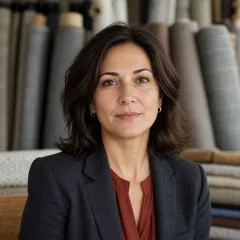
Lucia Bianchi is a woven apparel-fabric analyst covering cotton, linen, wool, rayon, denim, shirting, twill, satin, poplin, and blended garment fabrics. She applies the ISO 1833 series for fibre composition and ISO 105-C06 for laundering colourfastness while checking GSM, yarn count, usable width, shrinkage, skew, shade grade, drape, and surface defects. Her specification guides help designers, sourcing teams, and mills align fibre claims, lab dips, bulk tolerances, care conditions, and garment performance before production approval.